
The smallest OEM rotary valve in the world
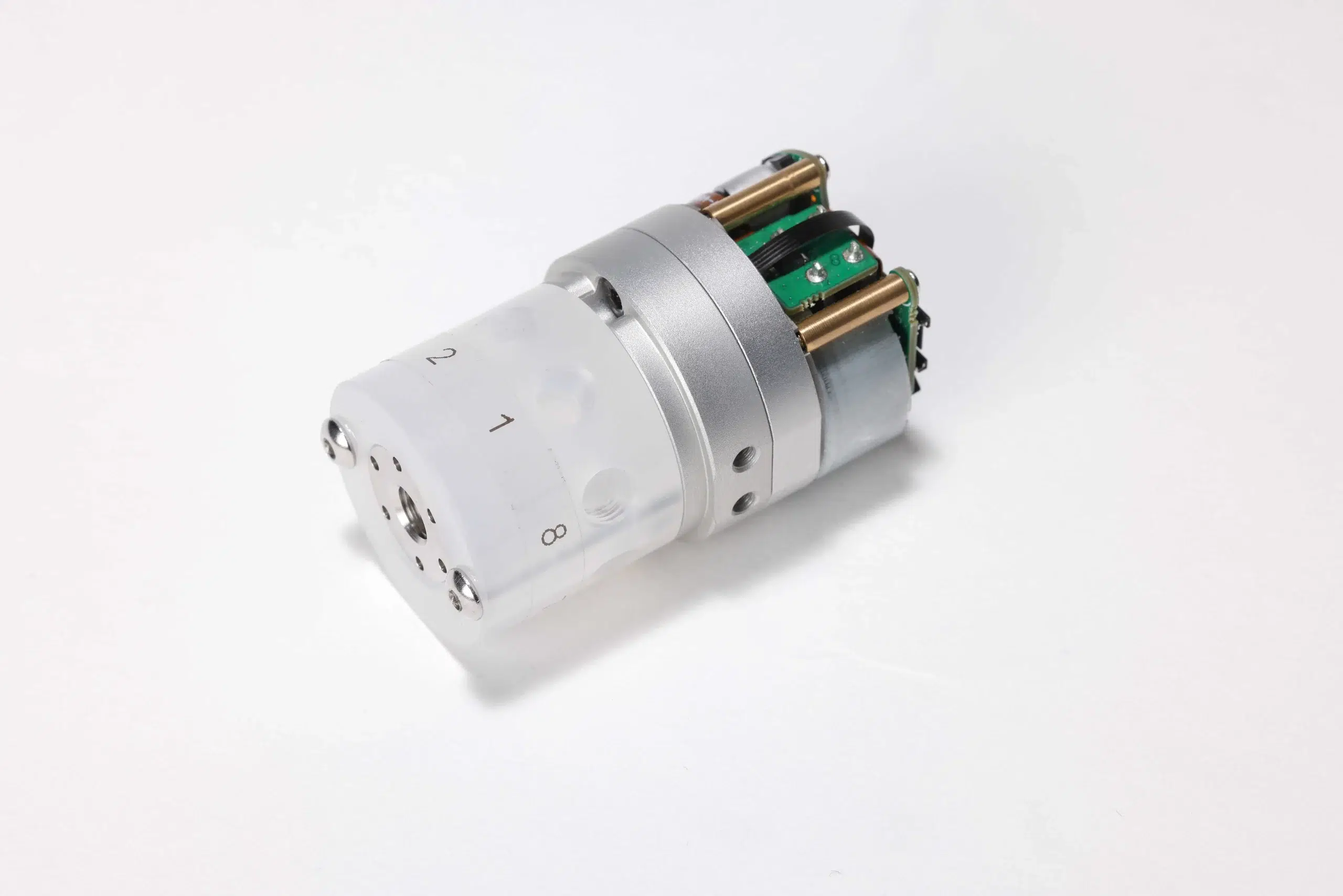
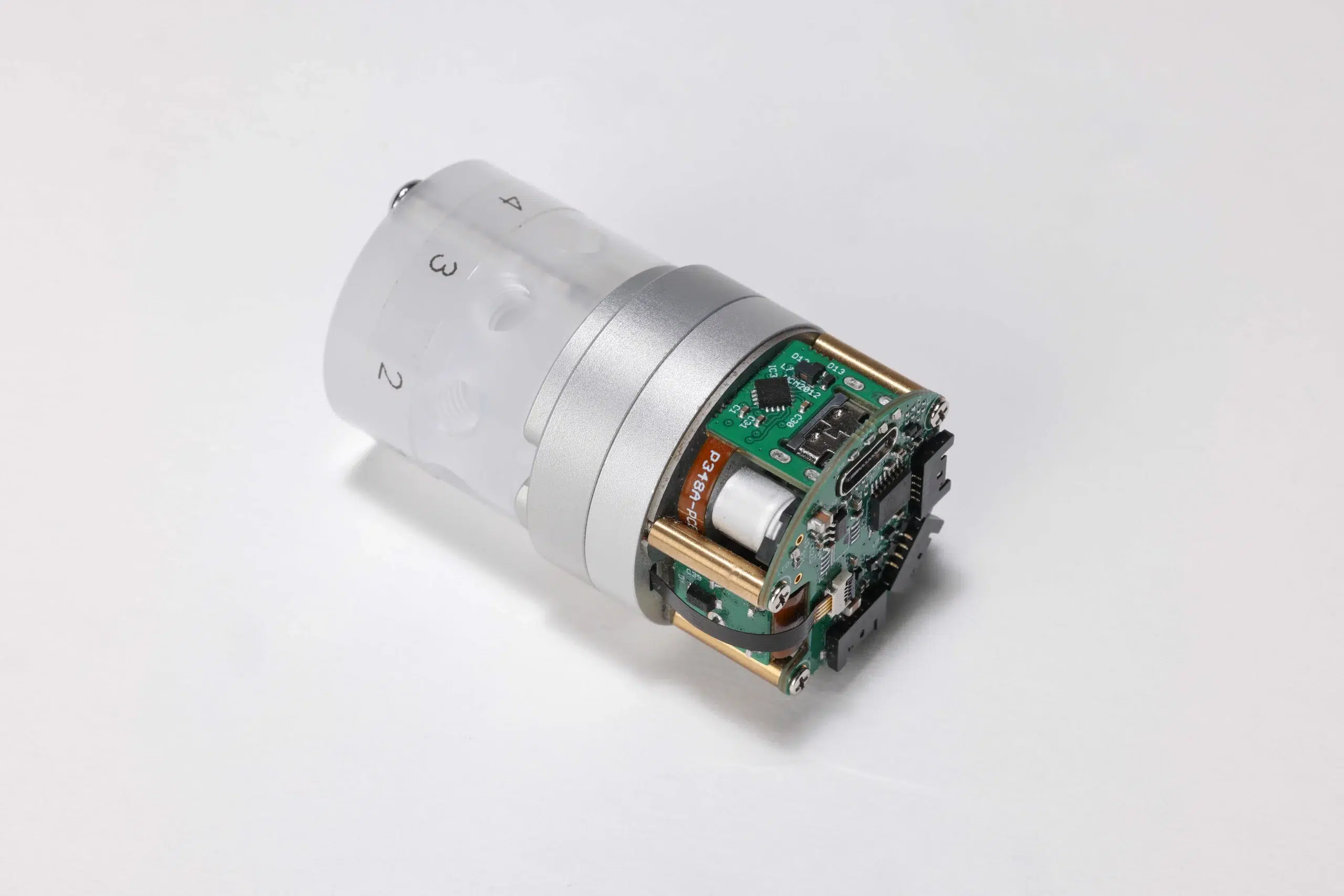
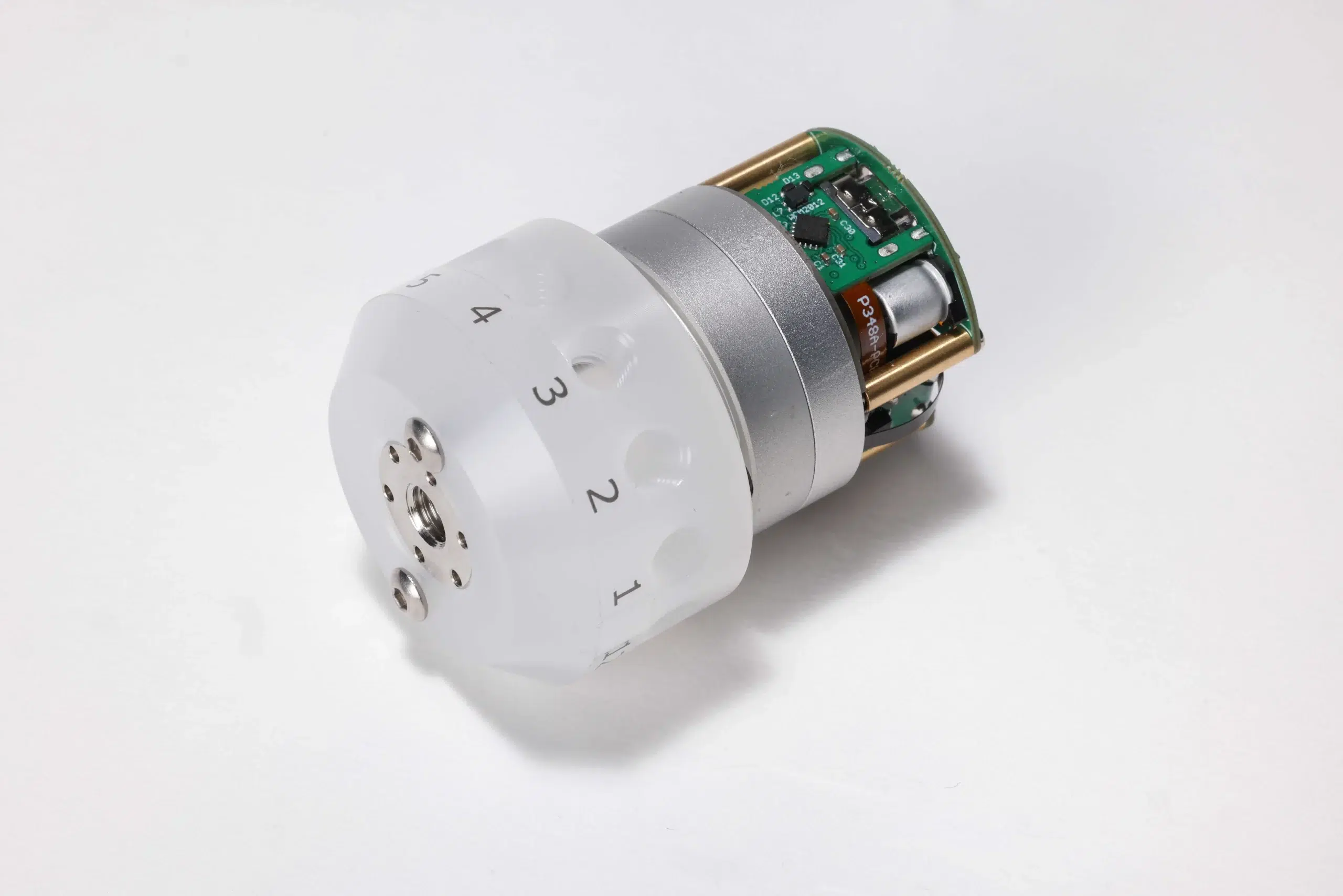
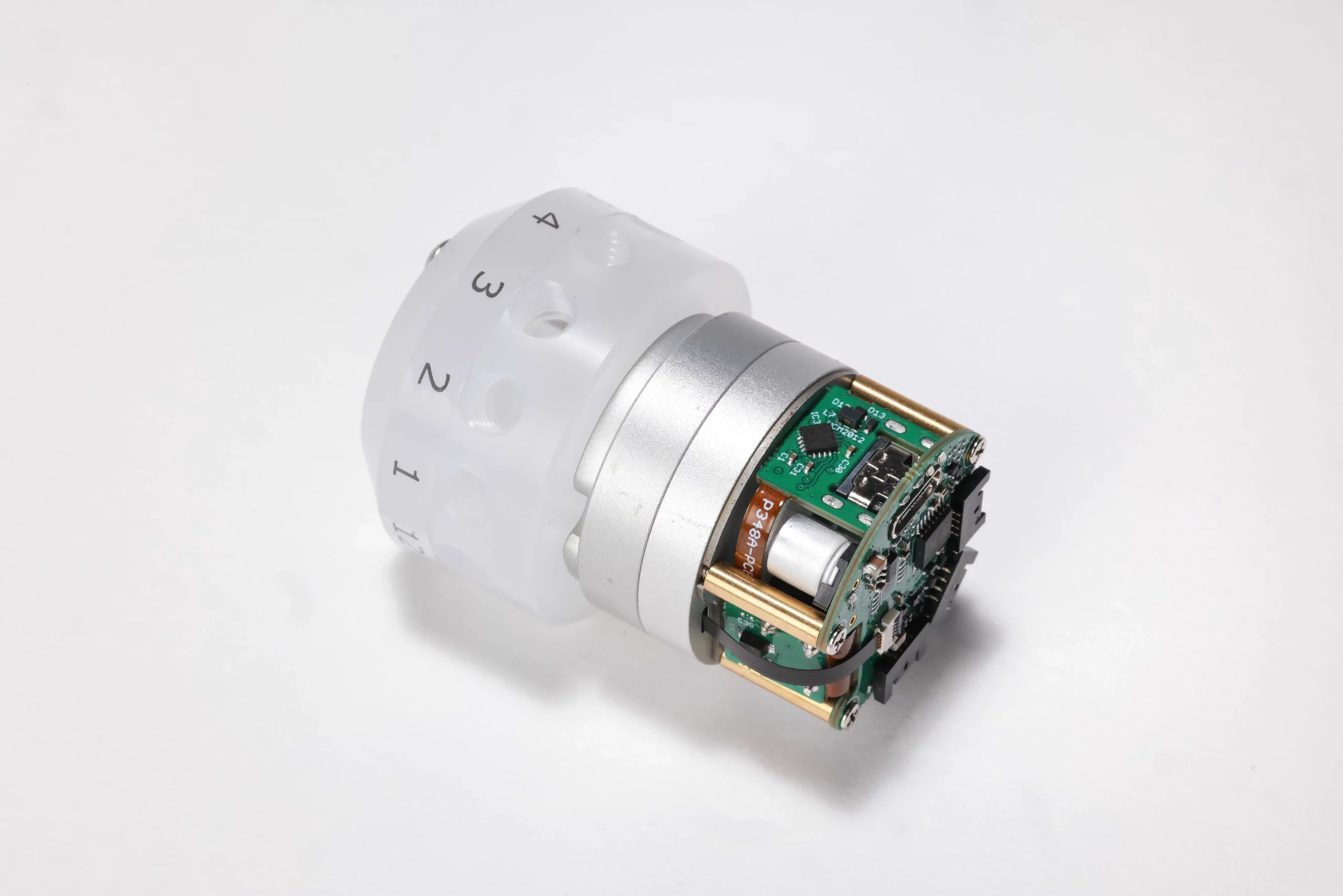
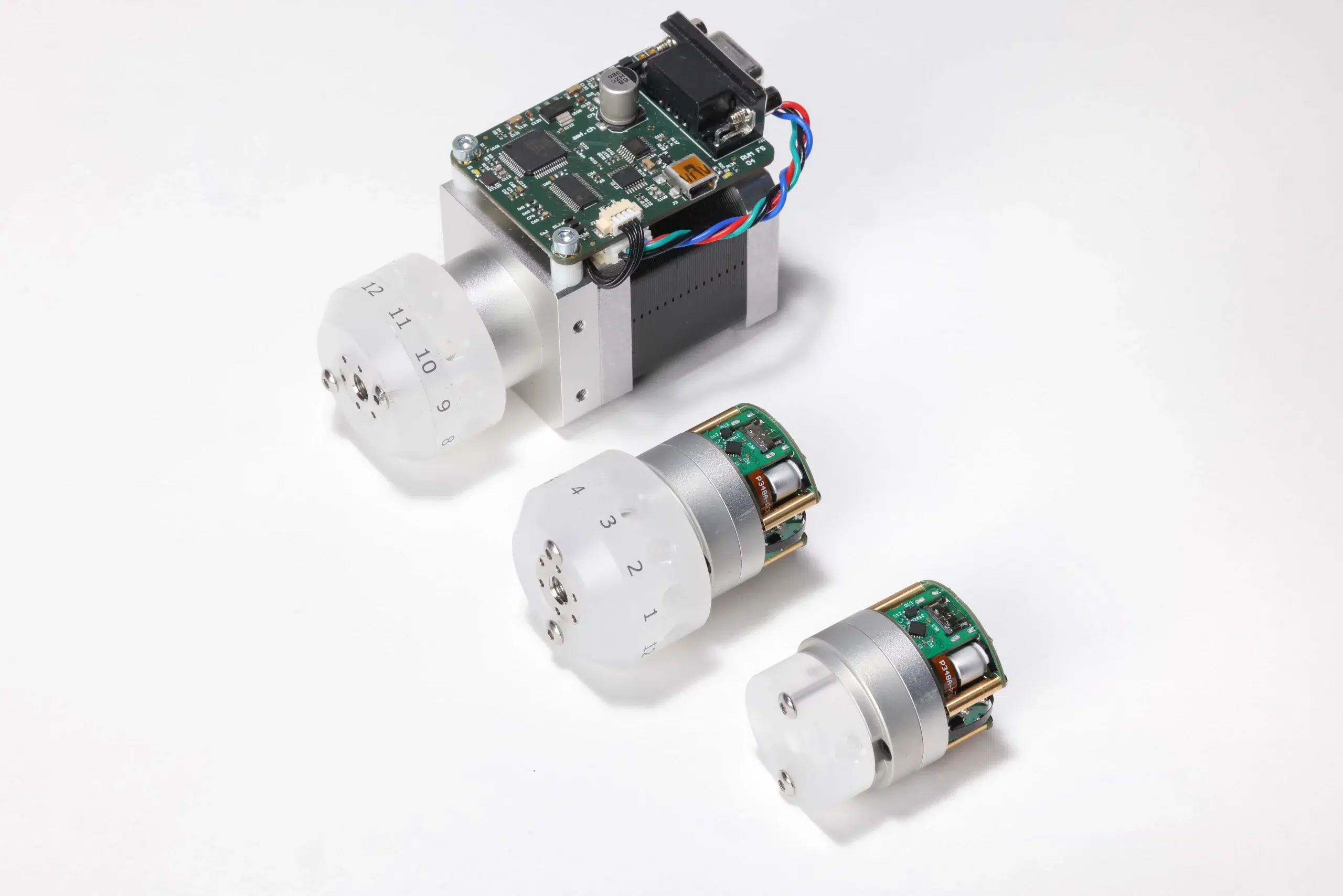
Fully integrated rotary valve with motor, and embedded electronics controler in one compact volume.
Designed for OEM systems where space is limited but performance cannot be compromised.
A new approach to fluid routing, enabling simpler architectures, cleaner integration, and higher system efficiency.
AMF is trusted by leaders
AMF is trusted by leading companies in diagnostics, biotech, and lab automation for high-precision microfluidic components and custom OEM systems.






Why compact integration matters
In modern OEM instruments, fluidic performance is often limited not by chemistry or mechanics, but by how components are integrated. As systems become smaller and more complex, integration challenges quickly impact footprint, reliability, and development time.
- Limited space inside compact instruments
- External controllers increase wiring and complexity
- Multiple interfaces increase integration risk
A more integrated approach to fluid routing enables simpler architectures, faster development, and more reliable systems.
Compact design and specifications for OEM integration
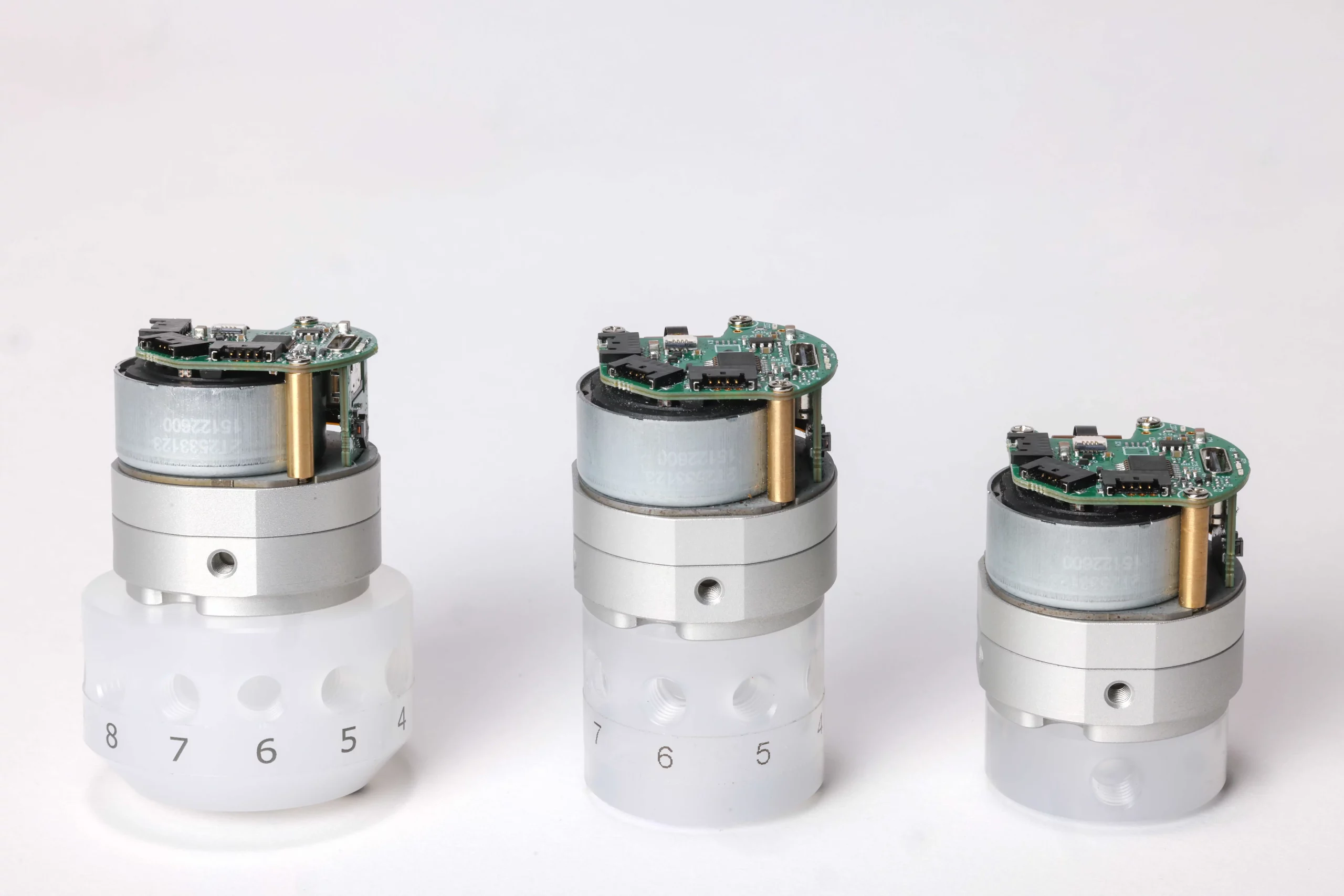
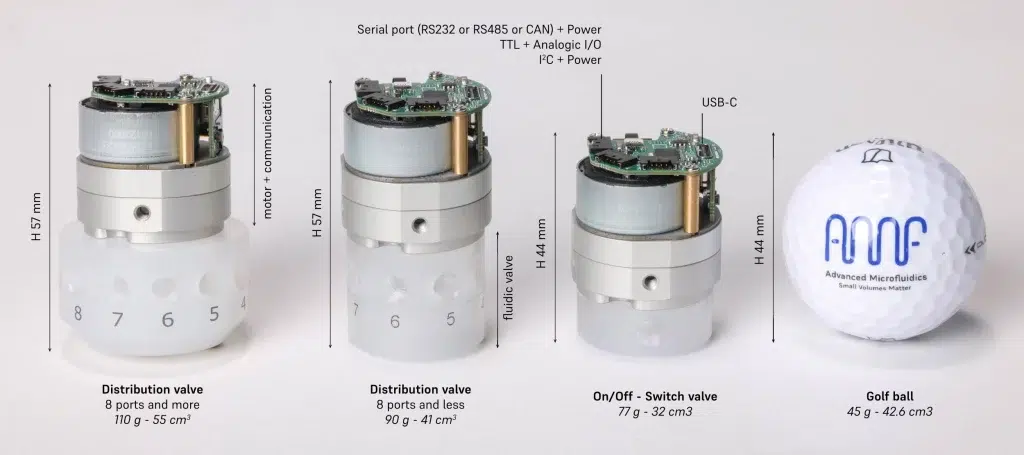
The RVM mini is engineered for space-constrained systems requiring high integration density without compromising fluidic performance. With a minimum volume of only 32 cm³ and a weight starting at 77 g, it enables efficient integration into compact instruments, portable devices, and automated fluidic platforms. Available in configurations from 2 to 12 ports, the valve supports flexible routing for multi-channel and automated fluid handling applications.
The valve head combines PCTFE and PTFE for broad chemical compatibility, with additional materials such as PEEK, UHMW-PE or full PTFE available for specific requirements. It integrates a new-generation electric motor and supports multiple communication interfaces, ensuring seamless integration into OEM systems. Designed as a robust microfluidic component, it can be easily integrated with tubing, pumps, sensors, and OEM control environments while remaining adaptable to industrial manufacturing constraints.
Key specifications and integration features:
- 32 cm³ volume, 77 g weight (min configuration)
- 2 to 12 ports for flexible fluid routing
- PCTFE and PTFE wetted materials, custom options available
- Compact electric motor with precise switching
- Multiple communication interfaces for seamless OEM integration
- Easy integration with tubing, pumps and control systems

Fully integrated control architecture
Motor, control electronics, and fluidic routing integrated into a single OEM component.
Simplifying OEM system integration
Traditional fluidic systems often rely on distributed architectures with separate motors, driver boards, connectors, and wiring harnesses. As systems become more compact and multi-channel, this approach increases integration complexity, footprint, and potential failure points.
The RVM mini addresses these challenges by embedding motion control and communication electronics directly into the rotary valve. Multiple communication interfaces, including USB-C, RS232, RS485, TTL, analog I/O, and I2C with power, are integrated into a single compact component, enabling simplified electrical and mechanical integration into OEM systems.
This architecture reduces external components while improving robustness, scalability, and ease of integration in automated microfluidic instruments.
Key integration benefits
- Embedded control electronics
- No external driver board required
- Reduced wiring and connector complexity
- Simplified OEM system integration
- Compact all-in-one architecture
- Multiple integrated communication interfaces

When solenoid valves reach their limits
A microfluidic rotary valve takes over
Solenoid valves are highly effective for simple fluidic tasks such as washing, purging, or waste management.
As systems become more compact and fluid routing becomes more complex, microfluidic requirements introduce new challenges, including dead volume, tubing complexity, carryover risk, and distributed control architectures.
The RVM mini addresses these limitations through compact rotary routing, embedded control electronics, and optimized internal fluidic geometries designed for advanced microfluidic systems.

Fluidic performance built on proven RVM technology
The RVM mini leverages the same fluidic architecture as the RVM Industrial Microfluidic Rotary Valve series, already validated across a wide range of microfluidic applications and industrial systems.
Its rotary valve design enables precise routing of fluids through multiple ports while maintaining optimized internal geometries for advanced liquid handling applications.
Precise fluid routing for advanced microfluidic applications
The RVM mini rotary valve leverages the same fluidic design as the RVM Industrial Microfluidic Rotary Valve series, already validated across a wide range of microfluidic applications and industrial systems. Its rotary valve architecture ensures precise control of fluid flow through multiple ports, with leak-tight rotary valve architecture, no dead volume and low carryover.
The optimized rotor-stator interface and reduced channel dimensions enable accurate and repeatable fluid routing in complex microfluidic systems, including chemical analysis, lab automation and microfluidic chip integration. This ensures high performance in liquid handling, even for small sample volumes or sensitive reagents.
Key fluidic benefits:
- Leak-tight rotary valve architecture
- No dead volume, low carryover
- Precise and repeatable flow control
- Optimized for small sample volumes
- Reliable performance in complex systems

Manifold integration for multi-stage fluidic systems
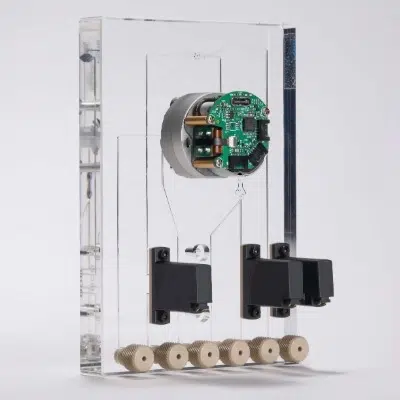
The RVM mini enables direct integration onto compact microfluidic manifolds, opening new possibilities for multi-stage and multi-layer fluidic architectures.
By integrating fluid routing directly inside the system structure, multiple fluidic paths can be managed within a reduced footprint while minimizing external tubing and connection complexity.
Enabling compact multi-layer fluidic architectures
This approach simplifies system integration, improves routing efficiency, and enables scalable fluidic architectures for advanced automated instruments.
The combination of compact rotary routing and manifold integration is particularly suited for applications requiring parallelized operations, multiplexing, random access workflows, and optimized handling of sensitive samples.
This manifold integration approach is currently patent pending.
To learn more about how the RVM mini enables compact multi-stage manifold architectures, discover our Microfluidic Manifold solutions.
RVM mini specifications
The RVM mini is designed to deliver full rotary valve functionality in an ultra-compact, fully integrated format.
Detailed specifications will be released at launch, but the key characteristics are outlined below.
Key features:
- Fully integrated motor, and embedded electronics controler
- Compact rotary valve designed for OEM integration
- Optimized internal flow paths for low dead volume
- Precise, repeatable channel switching
- Designed for continuous and automated operation
Applications:
Ideal for a wide range of applications, including:
- Diagnostic instruments
- Lab automation platforms
- Multi-step analytical systems
- Sample preparation and reagent routing
- Compact OEM fluidic modules
Model & motor specification
| Reference | Configuration | Power | Weight | Dimensions | Min. Switching time 180° | Switching time Port to Port | PCB functionnalities |
|---|---|---|---|---|---|---|---|
| P202-O - On/Off valve | Motor | 22-32 VDC, 0.5 A peak | 77 g | H: 44 mm - Ø32 mm up - Ø29 mm down | N/A | 580 ms in extended lifetime (down to 480 ms in some condition) | Drive, Encoder |
| P202-O - Switch valve | Motor | 22-32 VDC, 0.5 A peak | 77 g | H: 44 mm - Ø32 mm up - Ø29 mm down | N/A | 390 ms in extended lifetime (down to 310 ms in some condition) for a 6 ports valve | Drive, Encoder |
| P202-O - Distribution valve (8 ports and less) | Motor | 22-32 VDC, 0.5 A peak | 90 g | H: 57 mm - Ø32 mm up - Ø29 mm down | 850 ms in extended lifetime (down to 600 ms in some condition) | 300 ms in extended lifetime (down to 230 ms in some condition) for a 8 ports valve | Drive, Encoder |
| P202-O - Distribution valve (8 ports and more) | Motor | 22-32 VDC, 0.5 A peak | 110 g | H: 57 mm - Ø32 mm up - Ø39,5 mm down | 850 ms in extended lifetime (down to 600 ms in some condition) | 220 ms in extended lifetime (down to 180 ms in some condition) for a 12 ports valve | Drive, Encoder |
Other specifications
| Operating temperature | 15 – 40°C (59-104°F) |
| Storage temperature | 5 – 45°C (41-113°F) |
| Operating humidity | 20-80%, non condensing |
| Max. pressure | 7 bars (102 psi) |
| Wetted materials | PTFE or UHMW – PE, PCTFE |
| Channel diameter | 0.5 mm (0.020 in) or 1 mm (0.039 in) (other upon request) |
| Internal volume | 2.5 – 13.8 μL port-to-port (configuration dependent) |
| Carryover volume | 0.6 – 6.7 μL port-to-port (configuration dependent ) |
| Dead volume | None |
| Tube port fitting | Standard 1/4 – 28 UNF, flat-bottom |
| Electrical interface | USB-C, 3x Pico-Lock™ 1 mm pitch 4 pos. |
| Communication type | UART via USB or Serial (RS232/RS485), I2C, TTL (CAN upon request) |
Valve specifications
DISTRIBUTION SERIES
| Ref. | Configuration | Wetted materials | Internal volume | Carryover volume | Fluid path diameter | Max. pressure |
|---|---|---|---|---|---|---|
| V–D–1–6–050–C–P | 6 ports low carryover volume | PCTFE, PTFE | 2.5 μL | 1.5 μL | 0.5 mm | 7 bars |
| V–D–1–8–050–C–P | 8 ports low carryover volume | PCTFE, PTFE | 2.5 μL | 1.5 μL | 0.5 mm | 7 bars |
| V–D–1–8–100–C–P or U | 8 ports low carryover volume | PCTFE, PTFE or UHMW–PE | 13.8 μL | 6.7 μL | 1 mm | 7 bars |
| V–D–1–10–050–C–P or U | 10 ports low carryover volume | PCTFE, PTFE or UHMW–PE | 3.5 μL | 1.7 μL | 0.5 mm | 7 bars |
| V–D–1–10–100–C–P or U | 10 ports low carryover volume | PCTFE, PTFE or UHMW–PE | 13.8 μL | 6.7 μL | 1 mm | 7 bars |
| V–D–1–12–050–C–P or U | 12 ports low carryover volume | PCTFE, PTFE or UHMW–PE | 3.5 μL | 1.7 μL | 0.5 mm | 7 bars |
ON/OFF SERIES
| Ref. | Configuration | Wetted materials | Internal volume | Carryover volume | Fluid path diameter | Max. pressure |
|---|---|---|---|---|---|---|
| V–O–1–2–050–C–P | 2 ports | PCTFE, PTFE | 2.8 μL | - | 0.5 mm | 7 bars |
| V–O–1–2–075–C–P | 2 ports | PCTFE, PTFE | 6.6 µL | - | 0.75 mm | 7 bars |
SWITCH SERIES
| Ref. | Configuration | Wetted materials | Internal volume | Carryover volume | Fluid path diameter | Max. pressure |
|---|---|---|---|---|---|---|
| V–S–1–4–050–C–P | 4 ports ultra-low carryover volume | PCTFE, PTFE | 2.6 μL | 0.8 μL | 0.5 mm | 7 bars |
| V–S–1–6–050–C–P | 6 ports ultra-low carryover volume | PCTFE, PTFE | 2.4 μL | 0.6 μL | 0.5 mm | 7 bars |
Valve heads are interchangeable. Other models available upon request.
The above specifications are typical for our components and may vary due to multiple parameters / factors (e.g. fluid type, usage conditions…). Specifications are subject to change.


RVM mini
On/Off valve
Compact microfluidic on/off rotary valve designed for precise fluid isolation in automated OEM systems. The RVM mini delivers the functionality of a traditional 2/2 valve while reducing dead volume, minimizing carryover, and simplifying integration through embedded control electronics and compact fluidic routing.

RVM mini
Switch valve
Compact microfluidic switch rotary valve designed for injection and fluid path switching in automated OEM systems. The RVM mini enables accurate sample transfer while minimizing dead volume, reducing carryover, and simplifying integration through embedded control electronics and compact routing architecture.

RVM mini
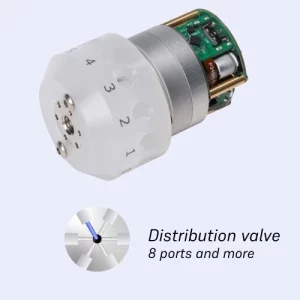
Distribution valve
Compact microfluidic distribution rotary valve designed for reagent and sample selection in automated OEM systems. The RVM mini enables flexible multi-channel routing while minimizing dead volume, reducing tubing complexity, and simplifying integration through embedded control electronics and compact architecture.
RVM mini
Distribution valve
High-density microfluidic distribution rotary valve designed for multiplexing and fluid selection in advanced OEM systems. The RVM mini enables scalable multi-channel routing while minimizing dead volume, reducing tubing complexity, and simplifying integration through embedded control electronics and compact architecture.
Designed for compact OEM systems
Fully integrated
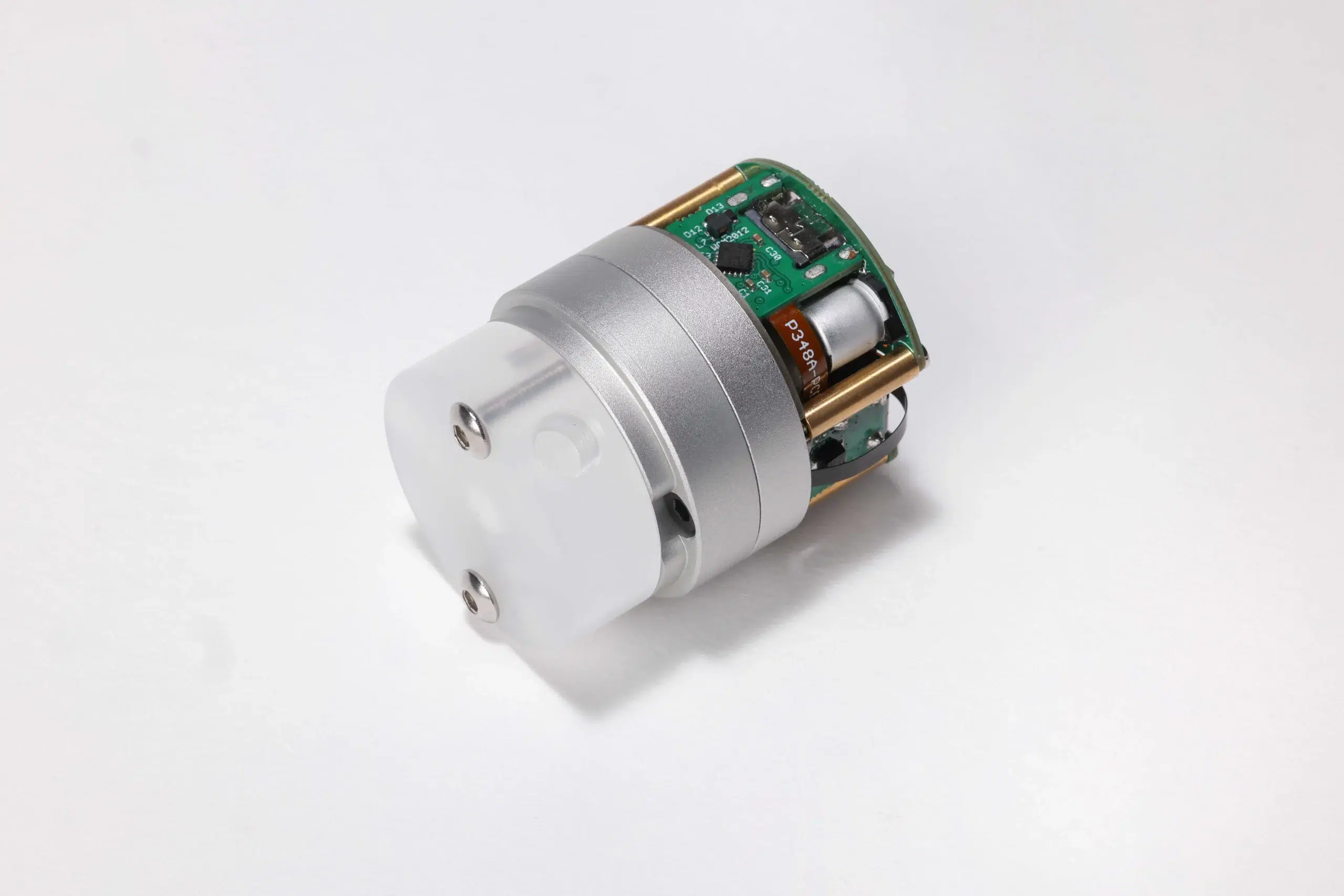
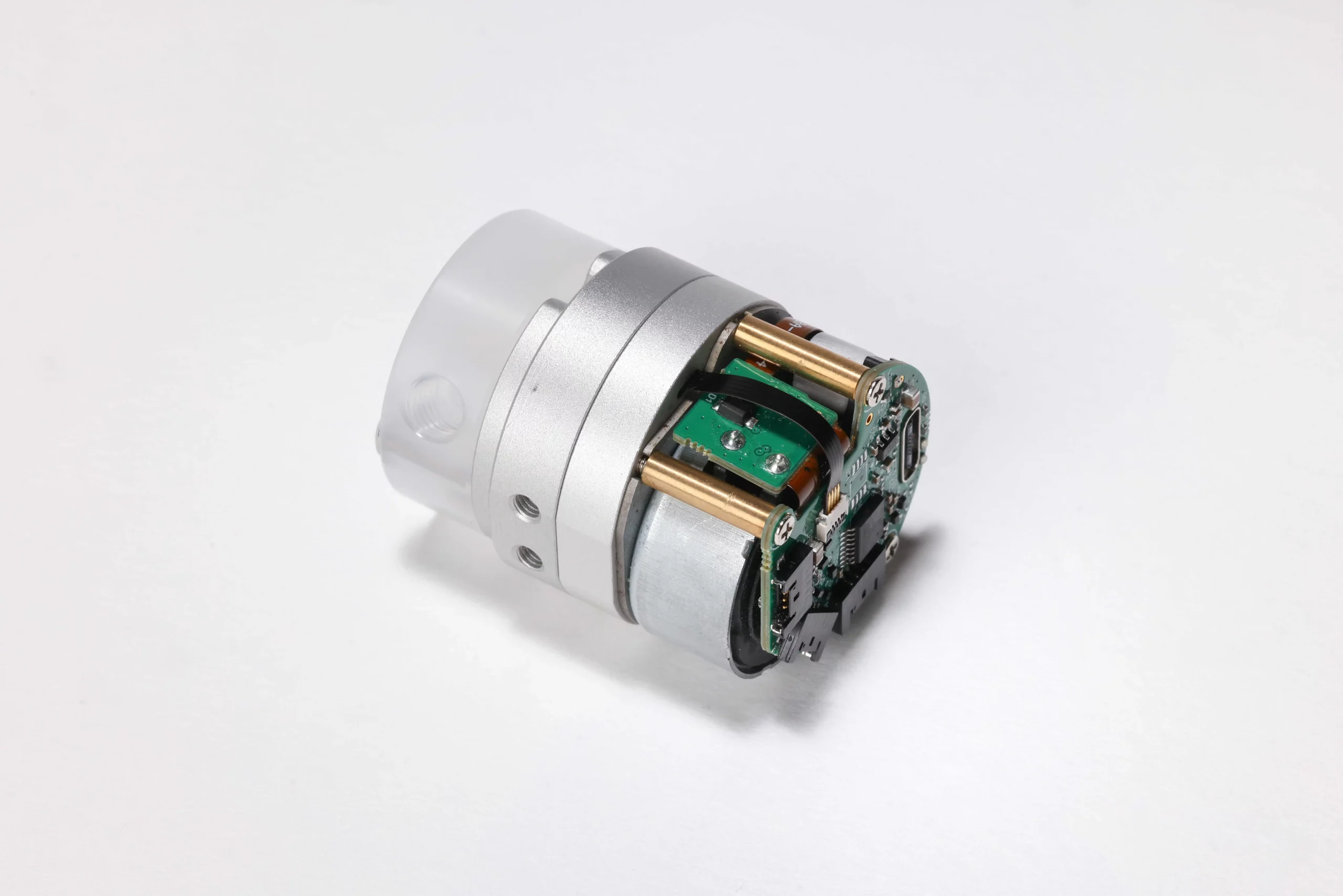
The rotary valve integrates the motor, drive electronics, and PCB directly into a single compact body. There is no external controller, no additional wiring harness, and no separate mounting for electronics. This reduces system complexity, shortens integration time, and limits potential failure points. For OEM developers, this means a cleaner architecture, easier validation, and faster transition from prototype to series production. Everything required to operate the valve is already embedded, enabling direct integration into space-constrained instruments without compromising control or performance.
Minimal footprint
Designed to fit where standard rotary valves cannot, this valve dramatically reduces the occupied volume inside an instrument. Its compact footprint frees up space for additional functions, shorter fluid paths, or smaller enclosures. By minimizing the space required for both the valve and its control hardware, OEMs can simplify mechanical design, reduce routing constraints, and design more compact systems. This is especially valuable in benchtop, portable, or multi-module instruments where every cubic centimeter matters.
Microfluidic by design
The internal flow paths and rotary positioning are optimized for precise, repeatable fluid routing. Tight mechanical tolerances and controlled motion ensure accurate switching between channels while minimizing internal volume and carryover. This design supports reliable handling of sensitive reagents, biological samples, and low-volume fluids. By combining precision mechanics with integrated control, the valve delivers consistent performance across repeated cycles, which is critical for automated workflows and demanding analytical or diagnostic applications.
OEM-ready
This rotary valve is built from the ground up for OEM integration and series production. It is designed to fit seamlessly into custom instruments, with flexibility for mechanical, fluidic, and electrical adaptation. Materials, interfaces, and configurations can be tailored to specific application needs, whether for diagnostics, lab automation, or industrial systems. OEM teams benefit from a component that is not only compact and precise, but also designed to scale reliably from early development to long-term production.
Fully integrated
The rotary valve integrates the motor, drive electronics, and PCB directly into a single compact body. There is no external controller, no additional wiring harness, and no separate mounting for electronics. This reduces system complexity, shortens integration time, and limits potential failure points. For OEM developers, this means a cleaner architecture, easier validation, and faster transition from prototype to series production. Everything required to operate the valve is already embedded, enabling direct integration into space-constrained instruments without compromising control or performance.
Minimal footprint
Designed to fit where standard rotary valves cannot, this valve dramatically reduces the occupied volume inside an instrument. Its compact footprint frees up space for additional functions, shorter fluid paths, or smaller enclosures. By minimizing the space required for both the valve and its control hardware, OEMs can simplify mechanical design, reduce routing constraints, and design more compact systems. This is especially valuable in benchtop, portable, or multi-module instruments where every cubic centimeter matters.
Microfluidic by design
The internal flow paths and rotary positioning are optimized for precise, repeatable fluid routing. Tight mechanical tolerances and controlled motion ensure accurate switching between channels while minimizing internal volume and carryover. This design supports reliable handling of sensitive reagents, biological samples, and low-volume fluids. By combining precision mechanics with integrated control, the valve delivers consistent performance across repeated cycles, which is critical for automated workflows and demanding analytical or diagnostic applications.
OEM-ready
This rotary valve is built from the ground up for OEM integration and series production. It is designed to fit seamlessly into custom instruments, with flexibility for mechanical, fluidic, and electrical adaptation. Materials, interfaces, and configurations can be tailored to specific application needs, whether for diagnostics, lab automation, or industrial systems. OEM teams benefit from a component that is not only compact and precise, but also designed to scale reliably from early development to long-term production.
A new generation of miniature rotary valves
This miniature rotary valve is designed for advanced microfluidic systems where precision, integration, and industrial scalability matter.
By combining compact size with fully integrated control, it enables new instrument architectures while remaining compatible with OEM development and series production.
New possibilities for compact fluidic architectures
A compact routing solution for multi-layer systems
The RVM mini is not only designed to be smaller. It enables new microfluidic architectures by simplifying how fluidic layers and functional zones are connected inside an instrument.
In complex OEM systems, routing fluids between different functional areas often requires multiple tubes, connectors, and external valves. This increases footprint, internal volumes, and integration complexity. In this application example, the RVM mini is integrated into a two-layer fluidic manifold combining solenoid valves and reaction chambers within a compact, structured block.
- Layer 1 hosts a first functional zone with a dedicated reaction chamber
- Layer 2 hosts a second functional zone with its own reaction chamber
- Integrated solenoid valves control inlets, outlets, waste, and wash lines
The challenge is to route fluids cleanly between these two layers without adding tubing bridges or unnecessary dead volume.

The role of the RVM mini
The RVM mini acts as a compact microfluidic router inside the manifold. Using a 3D rotary valve function, it directly interfaces layer 1 and layer 2 within the same integrated structure.
Instead of connecting layers with external tubing, the rotary valve provides a clean, internal transition between functional zones. All fluids pass through a single, controlled routing path, which can be fully flushed during wash steps. This simplifies cleaning and helps maintain consistent fluidic conditions over time.
By routing samples and reagents through the rotary valve, solenoid valves are only used for line selection and isolation. Reactive fluids do not pass through the solenoids, reducing contamination risk and extending component lifetime.
This architecture also enables random access operation. Each functional zone can be addressed independently, allowing the system to process samples as they arrive rather than following a fixed, fully sequential cycle.
Clean routing, full washability, and independent zone access are key to building compact, reliable, and flexible microfluidic instruments.
Inside the routing concept
The RVM mini is designed to do more than switch lines. Its internal rotary architecture enables controlled routing between multiple fluidic layers within a compact, integrated structure.
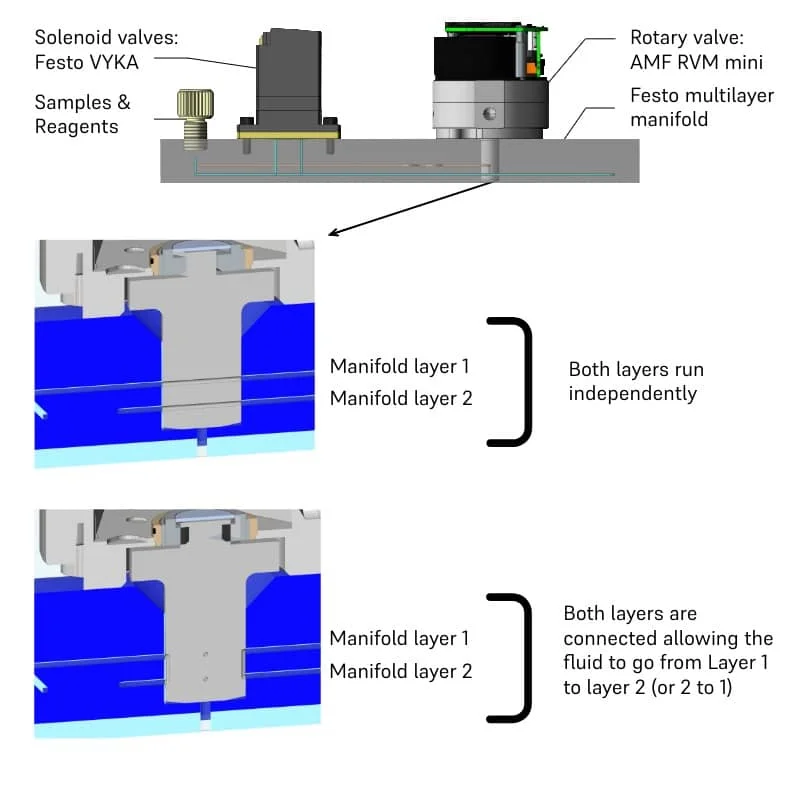
By embedding routing inside the valve itself, complex fluidic connections are handled internally. This reduces external tubing, simplifies integration, and enables compact multilayer designs without exposing sensitive routing to the rest of the system.
From sequential to parallelized operations
In many fluidic instruments, operations are performed sequentially, not because it is optimal, but because routing and zone independence are limited.
By combining a multilayer manifold with the RVM mini, fluidic operations can be reorganized to reduce idle time and improve overall efficiency and this enables:
Optimized footprint
Independent functional zones are enabled within a compact, multilayer manifold. Parallel operation is achieved without adding components or increasing the instrument footprint.
Multi-layer architecture
Multiple functional layers can be connected cleanly within the same fluidic block. Routing between layers is internal, controlled, and does not rely on external tubing.
Washable fluidic paths
All critical fluid routing passes through a single, controlled path that can be fully flushed. This simplifies cleaning, limits carryover, and supports reliable long-term operation.
Multiplexing and random access
Each zone can be addressed independently. Samples or reagents can be routed as needed, enabling multiplexing and random access workflows instead of fixed sequential cycles.
Better handling of sensitive samples
Optimized internal volumes, reduced dead volume, and fewer interfaces help protect valuable or sensitive samples from loss and contamination.
Improved system utilization
When one zone is incubating or waiting, the other can continue operating. Idle time is reduced and overall system efficiency improves without added complexity.

The visual comparison above highlights how clean routing and zone independence transform system performance.
What this changes at system level
By enabling cleaner routing and more independent functional zones, the RVM mini changes how microfluidic systems can be designed and operated.
The impact goes beyond fluid control and affects overall instrument performance, scalability, and robustness.
Shorter time per sample
Parallelized operations reduce idle phases during incubation and washing, shortening the overall processing time.
Higher throughput or more compact instruments
OEMs can increase throughput within the same footprint, or maintain performance while reducing instrument size and complexity.
Random access capability
Systems can process samples arriving at different times without waiting for a full batch cycle to complete.
Simpler and more robust architectures
Fewer tubes, connectors, and interfaces mean fewer leak points, easier assembly, and improved long-term reliability.
Better scalability for OEM production
Integrated routing simplifies manufacturing, validation, and long-term series production.
Shorter time per sample
Parallelized operations reduce idle phases during incubation and washing, shortening the overall processing time.
Higher throughput or more compact instruments
OEMs can increase throughput within the same footprint, or maintain performance while reducing instrument size and complexity.
Random access capability
Systems can process samples arriving at different times without waiting for a full batch cycle to complete.
Simpler and more robust architectures
Fewer tubes, connectors, and interfaces mean fewer leak points, easier assembly, and improved long-term reliability.
Better scalability for OEM production
Integrated routing simplifies manufacturing, validation, and long-term series production.
Our skills in a few numbers
We've sold over 19,000 products in the last few years, earning the trust of countless satisfied customers.
Valves Produced
We've successfully produced over 5,700 valves in the last few years, maintaning high quality standards.
Our growing client base now includes more than 250 partners, representing a diverse range of industries.
Benefit from our efficient production and delivery, with an average lead time of just 4 weeks for your projects.
Explore the AMF microfluidic ecosystem
From rotary valves and syringe pumps to fully customized fluidic systems, AMF develops high-precision microfluidic components designed for OEM integration, automation, and advanced liquid handling applications.
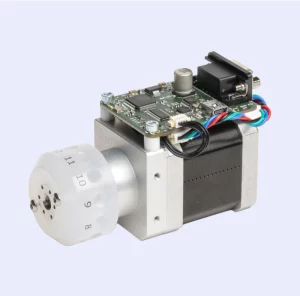
RVM series – OEM Rotary Valve Module
The RVM is an industrial-grade rotary valve optimized for high-precision fluid handling. Designed for continuous operation, it ensures low internal volume, minimal dead volume, and high durability, making it ideal for automated liquid handling and complex microfluidic systems.

RVM mini – Compact OEM Rotary Valve
Discover a new standard in compact fluid control with the RVM mini, an ultra-compact OEM microfluidic rotary valve designed for seamless system integration. It delivers precise and repeatable flow control with low internal volume, zero dead volume and ultra-low carryover.
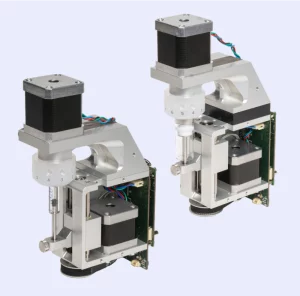
SPM series – OEM Syringe Pump Module
The SPM integrates a programmable syringe pump with rotary valve control, enabling precise dosing, sample preparation, and reagent mixing. This system is perfect for applications requiring controlled fluid movement, high accuracy, and automation compatibility.
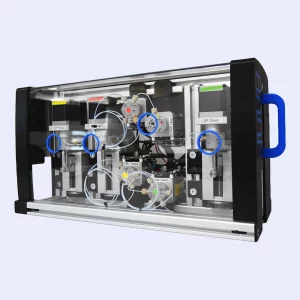
Custom microfluidic solutions
Need a tailored microfluidic valve solution? AMF specializes in custom designs to meet specific application needs. Whether you require a unique valve configuration, specialized materials, or enhanced automation features, our engineering team works closely with you to create a solution perfectly suited to your microfluidic system.
Microfluidic Valves, Automation & Integration - FAQ
A microfluidic rotary valve is a compact flow control component that uses a rotating mechanism to direct liquids between multiple microchannels. It enables precise, programmable switching for complex fluid handling tasks.
AMF valves are specifically designed for microfluidic use, with ultra-low internal volume, no dead volume, and OEM-ready integration. They’re built for automation, precision, and reliability in demanding environments.
The RVM mini is designed to be the smallest fully integrated OEM rotary valve, with the motor, electronics, and PCB embedded directly into the valve body. Exact dimensions will be disclosed at product launch.
Low dead volume means minimal liquid remains trapped inside the valve. This reduces sample loss and cross-contamination, essential for sensitive assays and high-value reagents.
Yes. Our valves are designed for seamless integration with automation systems, allowing real-time control of fluid flow in research instruments, diagnostic devices, or industrial platforms.
Multiplexing is the ability to handle multiple fluid channels or samples in parallel. AMF’s rotary valves support multiplexing by enabling fast, clean switching between several fluidic pathways within a single device.
Absolutely. Our valves are designed to connect with standard tubing, chips, and pumps. We also offer custom fittings and configurations to ensure compatibility with your specific system.
They’re used in diagnostics, cell culture, nanoparticle synthesis, continuous flow chemistry, environmental testing, and more, anywhere precise, programmable fluid control is required.
Yes. We specialize in OEM solutions and can adapt valve geometry, materials, and integration to fit your system architecture and application needs.


